
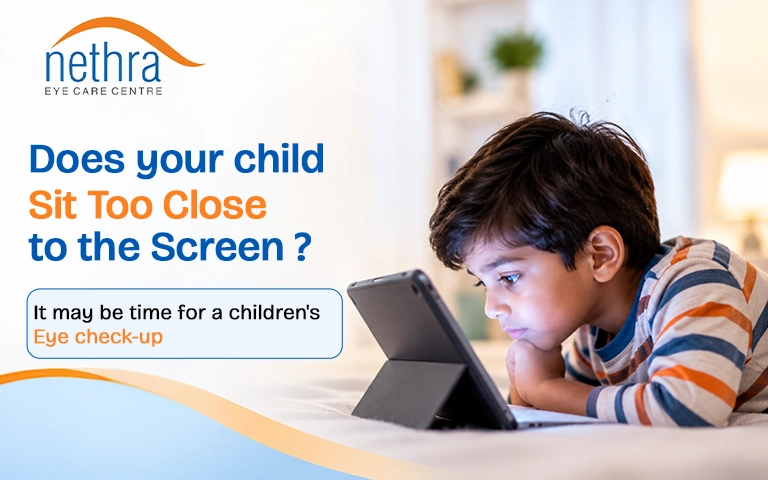
Why Does My Child Sit Too Close to the TV or Hold Books Very Close?
Have you noticed your child sitting unusually close to the television, bringing a book very close to their face or holding a mobile phone just a few inches away while watching videos?
Parents often wonder whether these habits are simply a matter of preference or could indicate a vision problem. While sitting close to a screen does not automatically mean that a child has an eye condition, repeatedly moving objects closer to see them clearly can sometimes be a sign that their vision needs to be checked.
A Children Eye Check-Up in Thrissur can help identify whether your child's viewing habits are related to nearsightedness or another vision problem.
Why Might a Child Sit Close to the TV?
There can be several reasons why a child prefers to sit close to the television or hold books near their face.
Some children may simply prefer being close to a screen. However, if your child consistently moves closer because distant objects appear unclear, it could be associated with a refractive error such as myopia.
Other possible reasons include:
Difficulty seeing small text or images
Uncorrected vision problems
Eye strain
Difficulty focusing
Poor visual habits
Simply preferring a closer viewing position
The only way to determine whether an eye condition is involved is through an appropriate eye examination.
Could It Be Nearsightedness?
One possible explanation is myopia, commonly known as nearsightedness.
A child with myopia may see nearby objects more clearly than objects at a distance. As a result, they may move closer to the television, classroom board, books or other objects to make them easier to see.
Other signs of possible myopia include:
Squinting to see distant objects
Sitting close to the classroom board or television
Holding books very close
Difficulty recognising people from a distance
Complaining that distant objects look blurry
Frequent headaches or eye discomfort
If these behaviours occur regularly, a children's eye examination can help determine whether your child needs vision correction.
Can Other Vision Problems Cause Similar Behaviour?
Yes. Myopia is not the only possible explanation.
Children can experience different types of refractive errors and focusing problems. In some cases, one eye may have significantly different vision from the other without the child being able to explain the problem.
Children may also not realise that their vision is different from that of other people. They may assume that the way they see is normal.
This is one reason routine eye examinations can be valuable, even when a child does not complain about poor vision.
What Happens During a Children's Eye Examination?
A pediatric eye check-up is designed to assess how well the child's eyes work individually and together.
Depending on the child's age and symptoms, an eye examination may include:
Vision Testing
The eye specialist checks how clearly the child can see at different distances.
Refraction
Refraction testing helps determine whether the child has myopia, hyperopia or astigmatism and whether glasses may be required.
Eye Alignment
The doctor checks whether both eyes are properly aligned and working together.
Eye Health Examination
The structures of the eyes are examined to identify any abnormalities that may affect vision.
Additional tests may be recommended depending on the child's age, symptoms and examination findings.
Why Is Early Detection Important?
Children rely heavily on their vision for learning, reading, sports and interacting with their surroundings.
An uncorrected vision problem may make classroom activities or reading more difficult. Some children may not complain because they do not realise their vision could be clearer.
Identifying a problem early allows appropriate vision correction and monitoring when required.
What Can Parents Do at Home?
Parents can pay attention to changes in their child's visual behaviour.
Look out for signs such as:
Sitting very close to the TV
Holding books or devices unusually close
Squinting frequently
Rubbing the eyes often
Tilting the head while reading
Covering one eye
Complaining of headaches
Difficulty seeing the classroom board
Avoiding reading or other visually demanding activities
These signs do not necessarily mean your child has an eye disease, but they are good reasons to consider an eye examination.
Parents should also encourage children to take regular breaks during prolonged screen use and spend time engaged in outdoor activities.
When Should Your Child Have an Eye Check-Up?
You do not have to wait until your child complains about blurred vision.
An eye examination may be particularly useful if there is a family history of myopia or other eye conditions, your child is showing noticeable changes in visual behaviour or teachers have raised concerns about seeing the board.
If your child develops a sudden change in vision, eye pain, significant redness, double vision or an eye injury, seek prompt professional evaluation.
Why Choose Nethra Eye Care for Children's Eye Care?
Nethra Eye Care provides comprehensive eye-care services for patients of different age groups. A detailed evaluation can help identify refractive errors and other eye concerns and guide parents regarding appropriate vision care.
For families looking for a Children Eye Check-Up in Thrissur, a professional examination can provide reassurance and help identify vision problems that may otherwise go unnoticed.
Frequently Asked Questions
1. Does sitting close to the TV mean my child has poor eyesight?
Not necessarily. However, consistently sitting close to screens or holding books very near the face can be a reason to have your child's vision checked.
2. Is myopia common in children?
Myopia can occur during childhood and adolescence. Children with myopia may have difficulty seeing distant objects clearly.
3. How can I tell if my child has a vision problem?
Look for signs such as squinting, sitting close to screens, holding books very close, difficulty seeing the board or frequent headaches. An eye examination is the best way to assess vision.
4. Can children have eye problems without complaining?
Yes. Children may not always recognise or communicate that their vision is unclear, particularly if the problem develops gradually.
5. Where can I get a children's eye check-up in Thrissur?
A comprehensive pediatric eye examination at Nethra Eye Care can help assess your child's vision and identify whether glasses, monitoring or further evaluation may be needed.
Give Your Child the Advantage of Clear Vision
Sitting close to the television or holding books very near the face does not always indicate an eye problem. However, if your child repeatedly does this or shows other signs of difficulty seeing, it is worth having their vision evaluated.
A timely Children Eye Check-Up in Thrissur can help identify refractive errors and other vision concerns and ensure that your child's eyes receive the appropriate care as they grow.

 Call
Now

