
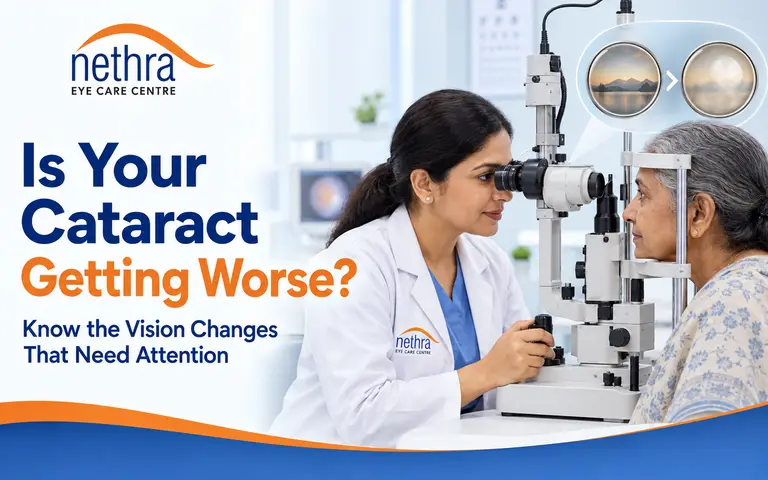
How Do You Know If a Cataract Is Getting Worse?
A cataract may be getting worse if your vision becomes increasingly cloudy, glare grows stronger, colours appear faded, or everyday activities such as reading and night driving become more difficult. Cataracts generally progress gradually, so the changes may not always be obvious at first.
Regular eye examinations help determine whether the cataract has progressed and whether another eye condition is contributing to the change. If your vision is beginning to limit your independence, an evaluation for Cataract Treatment in Thrissur can help you understand whether updated spectacles, continued monitoring or surgery is appropriate.
What Happens as a Cataract Progresses?
A cataract develops when the normally clear natural lens inside the eye becomes cloudy. The lens helps focus light on the retina, allowing the brain to receive a clear image.
During the early stage, clouding may affect only a small portion of the lens. You may have few symptoms or notice only minor difficulty in certain lighting conditions. As more of the lens becomes cloudy, less light passes through clearly. Vision can become blurred, dim or distorted.
Progression can differ between individuals. A cataract may change slowly over several years or become troublesome over a shorter period. Cataracts in both eyes may also progress at different rates.
What Are the Signs That a Cataract Is Getting Worse?
Worsening cataract symptoms usually involve a gradual decline in visual clarity or an increasing effect on daily life.
1. Vision Becomes More Cloudy or Blurred
Your vision may begin to feel as though you are looking through a foggy, frosted or dirty window. Details that were previously clear may become harder to recognise.
You may notice difficulty:
- Reading small print
- Recognising faces from a distance
- Watching television
- Seeing road signs
- Completing detailed work
- Moving around in dimly lit places
Blurred vision can also be caused by refractive errors, dry eyes, retinal conditions or other problems. An examination is needed to confirm whether the cataract is responsible.
2. You Need Brighter Light to Read
As a cataract progresses, ordinary room lighting may no longer feel sufficient. You may begin positioning yourself closer to a lamp or increasing screen brightness to see clearly.
Needing stronger light occasionally is not enough to confirm cataract progression. However, a continuing increase in lighting needs should be discussed with an ophthalmologist.
3. Glare Becomes More Disturbing
A cloudy lens can scatter light instead of allowing it to pass through evenly. This can make sunlight, streetlights and indoor lighting feel uncomfortable.
Glare may become particularly noticeable while driving towards bright sunlight or facing headlights at night.
4. You See Halos or Starbursts Around Lights
Headlights, lamps and other light sources may appear surrounded by rings, streaks or starburst patterns. These effects can make night driving difficult and reduce confidence on unfamiliar roads.
Increasing halos should be evaluated because they may also occur with corneal problems, glaucoma or other eye conditions.
5. Night Vision Becomes Poorer
A worsening cataract can make it difficult to see in dim lighting. You may struggle to identify pedestrians, road edges, steps or objects in poorly lit rooms.
Night-driving difficulty is an important functional concern. Even if you can read an eye chart reasonably well during the day, glare and reduced contrast may make driving unsafe.
6. Colours Appear Faded or Yellowish
Cataracts can change how colours are perceived. White objects may look yellowish, while bright colours may appear dull or less distinct.
This change often develops slowly. Some people only realise how much colour perception had changed after the cataract is removed from one eye and they compare the two eyes.
7. Your Spectacle Prescription Changes Frequently
An updated prescription may temporarily improve vision during the early stages of a cataract. As the lens continues to change, however, spectacle power may need repeated adjustment.
If new glasses stop helping after a short period, the cataract may be progressing. Frequent prescription changes should prompt a complete eye examination rather than repeated spectacle purchases alone.
8. You Experience Double Vision in One Eye
A cataract can sometimes cause overlapping or multiple images in the affected eye. This is called monocular double vision because it may continue even when the other eye is covered.
Double vision has several possible causes. Sudden double vision requires prompt medical evaluation.
9. Your Vision Seems Dimmer
You may feel that rooms are less bright or that a film is covering your sight. This can affect contrast, making it difficult to distinguish an object from its background.
For example, you may struggle to see a dark step, recognise facial expressions or locate items on a similarly coloured surface.
How Can Cataract Progression Affect Daily Activities?
The practical effect of a cataract is often more important than its appearance alone. Two people with a similar level of lens clouding may experience very different difficulties depending on their work, lifestyle and visual requirements.
A cataract may be significantly affecting you if it interferes with:
- Reading books, newspapers or medicine labels
- Driving safely, especially at night
- Recognising faces
- Cooking or handling sharp objects
- Using stairs confidently
- Working on a computer
- Sewing or performing detailed tasks
- Watching television
- Participating in hobbies
- Moving independently outside the home
Family members may notice changes before the patient does. They may observe that the person avoids driving, requires more assistance, frequently misses steps or sits closer to the television.
These changes are useful to mention during an evaluation for Cataract Treatment in Thrissur because treatment decisions should reflect how vision affects the patient’s real life.
Can You Check Cataract Progression at Home?
You cannot reliably measure cataract progression without an eye examination. However, you can observe changes between appointments.
Try asking yourself:
- Is one eye clearer than the other?
- Do I need more light than I did a few months ago?
- Have headlights become more disturbing?
- Am I avoiding night driving?
- Do colours appear dull?
- Are my glasses no longer helping?
- Is poor vision affecting my confidence or independence?
You can compare each eye separately by covering one eye at a time while looking at the same object. This may help you notice a difference, but it is not a substitute for professional testing.
Do not attempt to diagnose the severity of a cataract using photographs, mirrors or online vision tests.
How Does an Eye Doctor Check Whether a Cataract Is Worsening?
An ophthalmologist evaluates both the cataract and the overall health of the eye. The assessment may include the following tests.
Visual Acuity Testing
A visual acuity test measures how clearly you can see at different distances. Results may be compared with previous examinations to identify changes.
Refraction Testing
Refraction checks whether an updated spectacle prescription improves vision. If vision remains limited despite appropriate correction, the cataract or another condition may be responsible.
Slit-Lamp Examination
A slit lamp provides a magnified view of the front structures of the eye. It allows the ophthalmologist to examine the location, type and extent of lens clouding.
Dilated Eye Examination
Dilating drops widen the pupil so the doctor can examine the lens, retina and optic nerve. This helps confirm the cataract and identify other conditions that could affect the expected visual result.
Eye-Pressure Measurement
Eye pressure may be checked to assess glaucoma risk or identify another concern requiring attention.
Retinal Imaging When Required
Optical coherence tomography or other retinal imaging may be recommended if the doctor suspects macular disease, diabetic retinopathy or another retinal condition.
This complete evaluation matters because not every decline in vision is caused by cataract progression.
When Is Cataract Surgery Considered?
Cataract surgery may be considered when vision loss begins interfering with activities that are important to you. The decision is usually based on symptoms, examination findings, eye health and personal needs—not simply on age or the presence of a cataract.
During cataract surgery, the cloudy natural lens is removed and replaced with a clear artificial intraocular lens. Surgery is the only treatment that removes the cataract; medicines, exercises and dietary changes cannot reverse existing lens clouding.
However, having a cataract does not always mean that immediate surgery is necessary. Your ophthalmologist should explain:
- Whether the cataract is responsible for your symptoms
- How much it affects your daily activities
- Whether another eye condition is present
- The proposed surgical technique
- Suitable intraocular lens options
- Possible benefits and limitations
- Surgical risks and recovery requirements
- Whether spectacles may still be required
The right time for surgery is an individual decision made after informed discussion.
Should You Wait Until a Cataract Is Fully Mature?
Usually, there is no need to wait for a cataract to become “fully mature” before discussing surgery. Modern treatment decisions are generally based on how much the cataract affects vision and daily functioning.
Waiting may be reasonable when symptoms are mild and routine activities remain comfortable. However, delaying assessment despite worsening vision can increase the risk of falls, driving difficulty and loss of independence.
Certain advanced cataracts may also become more technically challenging to manage. The ophthalmologist can recommend an appropriate monitoring or treatment schedule based on your eye.
Can Cataract Progression Be Slowed?
No method can guarantee that a cataract will stop progressing. However, certain habits support general eye health and may reduce avoidable risk:
- Wear UV-protective sunglasses outdoors
- Use protective eyewear during hazardous activities
- Avoid smoking
- Manage diabetes with medical guidance
- Eat a balanced diet
- Use steroid medicines only as prescribed
- Attend scheduled eye examinations
These measures cannot clear an existing cataract. Avoid eye drops, supplements or home remedies claiming to dissolve cataracts unless they have been specifically recommended by a qualified ophthalmologist.
Which Symptoms Are Not Typical of Gradual Cataract Progression?
Cataracts usually cause gradual and painless vision changes. Sudden symptoms may indicate another eye condition and require prompt attention.
Seek urgent medical care for:
- Sudden loss or reduction of vision
- Severe eye pain
- Sudden double vision
- New flashes of light
- A sudden increase in floaters
- A curtain-like shadow across the vision
- Significant redness with blurred vision
- Eye injury or chemical exposure
- Headache, nausea and halos accompanied by eye pain
Do not wait for a routine cataract appointment if these symptoms occur.
Cataract Evaluation at Nethra Eye Care Centre
Nethra Eye Care Centre provides cataract evaluation and surgical care for patients across the Thrissur district. Its cataract services include phacoemulsification and manual small-incision cataract surgery, with the chosen approach based on the patient’s eye condition and clinical requirements. Nethra Eye Care Centre
Patients considering Cataract Treatment in Thrissur can visit Nethra Eye Care centres in Irinjalakuda, Kodungallur or Mala for an examination. The ophthalmologist can assess whether the cataract has progressed, explain treatment options and provide guidance suited to the patient’s visual needs.
Frequently Asked Questions
How quickly can a cataract worsen?
The rate differs between individuals. Some cataracts progress slowly over several years, while others change more quickly. Diabetes, eye injury, steroid use and the type of cataract may influence progression.
Can stronger glasses correct a worsening cataract?
An updated prescription may improve vision temporarily during the early stages. As clouding increases, glasses may no longer provide adequate clarity.
Does a worsening cataract cause eye pain?
Cataracts typically cause painless, gradual vision changes. Eye pain, sudden redness or rapid vision loss requires prompt evaluation for another possible condition.
Can a cataract spread from one eye to the other?
No. Cataracts may develop in one or both eyes, but they do not spread between eyes. Each eye may progress at a different rate.
Will delaying cataract surgery damage my eye?
Many people can safely monitor a mild cataract. However, the decision depends on the cataract type, eye health and effect on daily life. Follow the examination schedule advised by your ophthalmologist.
Conclusion
A cataract may be worsening when cloudy vision, glare, faded colours, frequent spectacle changes or poor night vision become more noticeable. The clearest sign is often its growing effect on reading, driving, work and independence.
If you have noticed these cataract vision changes, schedule an assessment at Nethra Eye Care Centre. A detailed evaluation can determine whether continued monitoring, updated spectacles or Cataract Treatment in Thrissur is appropriate for you.

 Call
Now
Call
Now

